2026 · The Astrophysical Journalsubmitted

Confidently Wrong: Why Ignoring Binaries Biases IMF Inference at Large Sample Sizes

Rosen, A. L.

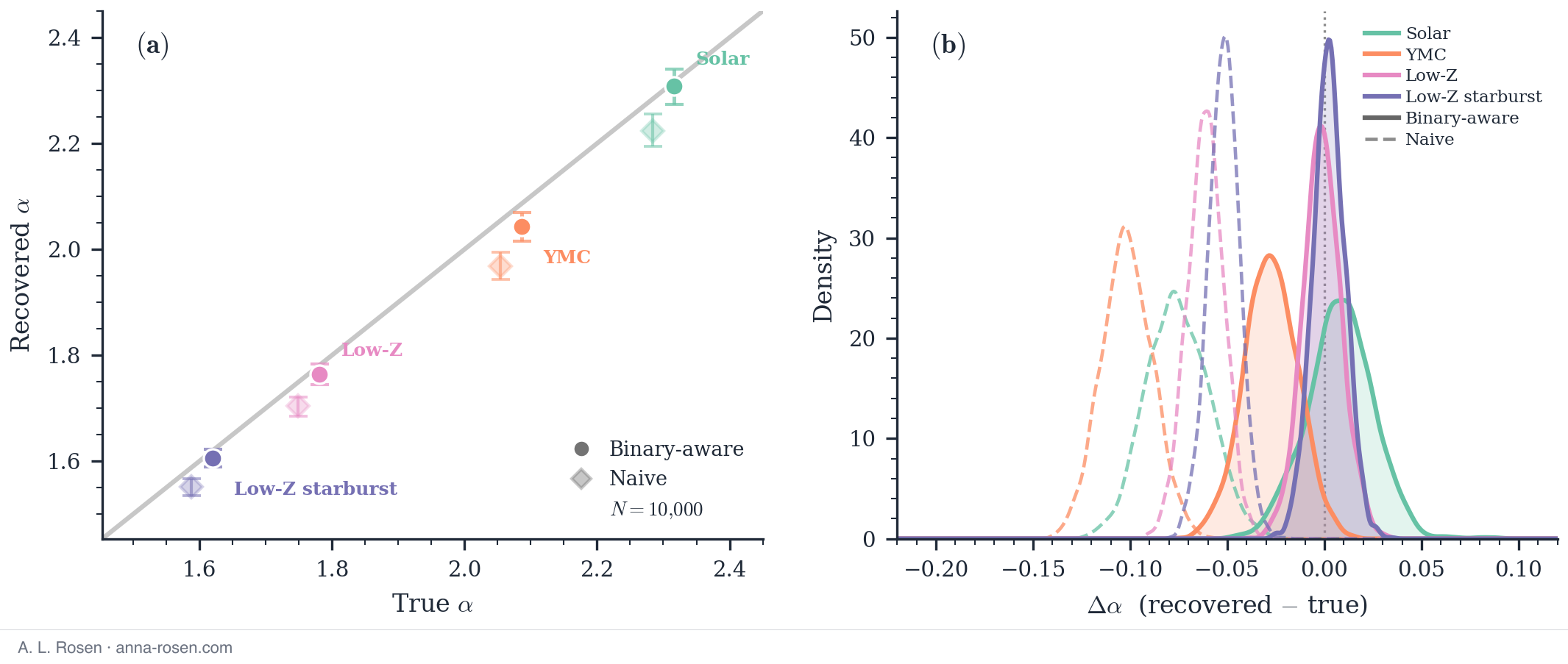
The stellar mass function's high-mass slope is usually measured by fitting single-star models to clusters — but most massive stars have unseen binary companions, and ignoring them biases the answer by a fixed amount. Because statistical error shrinks with sample size while this bias does not, huge upcoming surveys (Gaia, JWST, Roman, LSST) will report slopes that are precise yet wrong — a regime I call "confidently wrong." A binary-aware analysis recovers the true slope.

Two panels. Left: recovered versus true high-mass IMF slope for four environments; binary-aware estimates (filled circles) sit on the one-to-one line while naive estimates (open diamonds) fall consistently below it. Right: posterior distributions of the error in the recovered slope; every naive posterior (dashed) is shifted left of zero, while every binary-aware posterior (solid) is centred on zero.
Ignoring binaries does not add noise — it moves the answer. Naive fits (dashed, open) are offset low in all four environments; binary-aware fits (solid, filled) recover the truth.Figure 3 of Rosen (2026), submitted.

2022 · ApJ, 941, 202

A Massive Star is Born: How Feedback from Stellar Winds, Radiation Pressure, and Collimated Outflows Limits Accretion onto Massive Stars

Rosen, A. L.

As a massive star grows, its intense luminosity can drive winds that push back on the very gas it is trying to accrete. These 3D radiation-magnetohydrodynamic simulations — the first to include isotropic stellar winds alongside radiation and outflows — show the winds carve asymmetric, bipolar "wind-tunnel" bubbles and eventually shut off accretion onto ~30 M☉ stars. Building anything bigger therefore needs extra gas funneled in from the surrounding cloud.

2020 · Astronomical Journal, 160, 78

The Role of Outflows, Radiation Pressure, and Magnetic Fields in Massive Star Formation

Rosen, A. L., Krumholz, M. R.

Which feedback actually limits how massive a forming star can get? These simulations pit magnetically-driven jets against radiation pressure. Protostellar outflows punch holes in the dusty envelope that let radiation leak out, and magnetic fields broaden the escaping outflow — making outflows a far more effective brake on a star's growth than radiation pressure alone.

2020 · Space Science Reviews, 216, 62

Zooming in on Individual Star Formation: Low- and High-mass Stars

Rosen, A. L., Offner, S. S. R., Sadavoy, S. I., Bhandare, A., Vázquez-Semadeni, E., Ginsburg, A.

A review of how stars form across scales — from giant molecular clouds down to the dense cores where individual stars ignite. It traces the past decade's leap in understanding, driven by multi-wavelength surveys, multi-physics simulations, and synthetic observations, for both low- and high-mass stars.

2019 · ApJ, 887, 108

Massive Star Formation via the Collapse of Subvirial and Virialized Turbulent Massive Cores

Rosen, A. L., Li, P. S., Zhang, Q., Burkhart, B.

Does a massive star's birth depend on how turbulent its parent core is? These radiation-hydrodynamic simulations compare "subvirial" cores (too weakly turbulent to hold themselves up) with virialized ones. Subvirial cores collapse fast and monolithically, while virialized cores fragment into many companions early on — though massive, unstable accretion disks eventually spawn companions either way.

2017 · Journal of Computational Physics, 330, 924

HARM²: A Highly Parallel Method for Radiation Hydrodynamics on Adaptive Grids

Rosen, A. L., Krumholz, M. R., Oishi, J. S., Lee, A. T., Klein, R. I.

A new algorithm for the hard problem of radiation in star-formation simulations. HARM² combines ray-tracing for the sharp light of stars with a moment method for the diffuse, dust-reprocessed glow, runs on adaptive grids, and — thanks to a new non-blocking communication scheme — scales efficiently to thousands of processors.

2016 · MNRAS, 463, 2553

An Unstable Truth: How Massive Stars get their Mass

Rosen, A. L., Krumholz, M. R., McKee, C. F., Klein, R. I.

How does gas reach a massive star against its blinding radiation? With a more accurate radiation method and properly resolved simulations, this work shows matter funnels onto the star through gravitational and Rayleigh–Taylor instabilities — filamentary channels threading through radiation-blown bubbles — settling a debate that had hinged on numerical resolution.

2014 · MNRAS, 442, 2701

Gone with the Wind: Where is the Missing Stellar Wind Energy from Massive Star Clusters?

Rosen, A. L., Lopez, L. A., Krumholz, M. R., Ramirez-Ruiz, E.

Young massive clusters inject as much energy through stellar winds as through supernovae — but where does it go? Accounting for every energy channel in four well-studied clusters, this work finds none can absorb it, pointing to turbulent mixing or hot-gas leakage from H II regions as the missing sink — with real consequences for how clusters shape their surroundings.

2012 · ApJ, 748, 97

What Sets the Initial Rotation Rates of Massive Stars?

Rosen, A. L., Krumholz, M. R., Ramirez-Ruiz, E.

Massive stars spin fast — but why? Low-mass stars get braked by magnetic coupling to their disks; this angular-momentum model shows the same brakes are far too weak for massive stars, which form too quickly and accrete too hard to be slowed. They are likely born as rapid rotators unless their disks survive far longer than observations suggest.

Longer plain-language write-ups of individual papers live in astrobytes. The summaries above cover selected first-author papers. The complete list below is synced automatically from ORCID, and is also on NASA ADS.

Full bibliography 37 works

First-author 9

2020

2019

2017

2016

2014

2012

Co-authored 28

2026

2025

2024

2023

2022

2021

2020

2018

2015