A snapshot rather than a record. If the date below is old, so is this page.
Updated July 21, 2026
The work happens in San Diego, at 32.8° N.
Plot of the moment
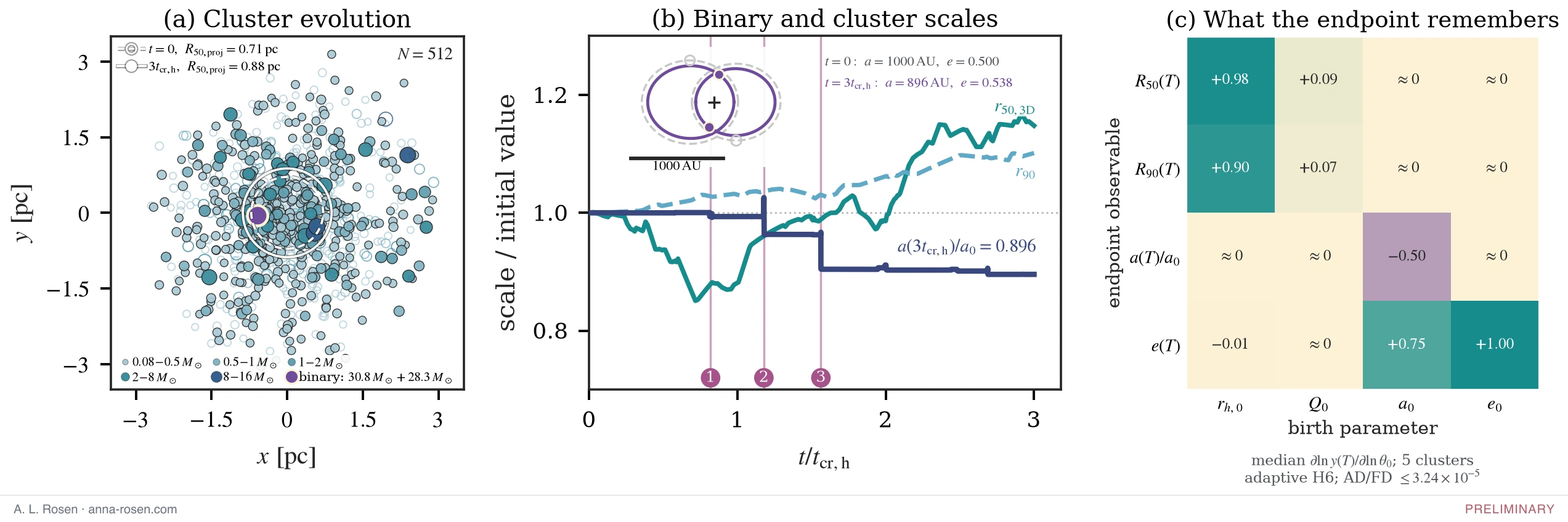
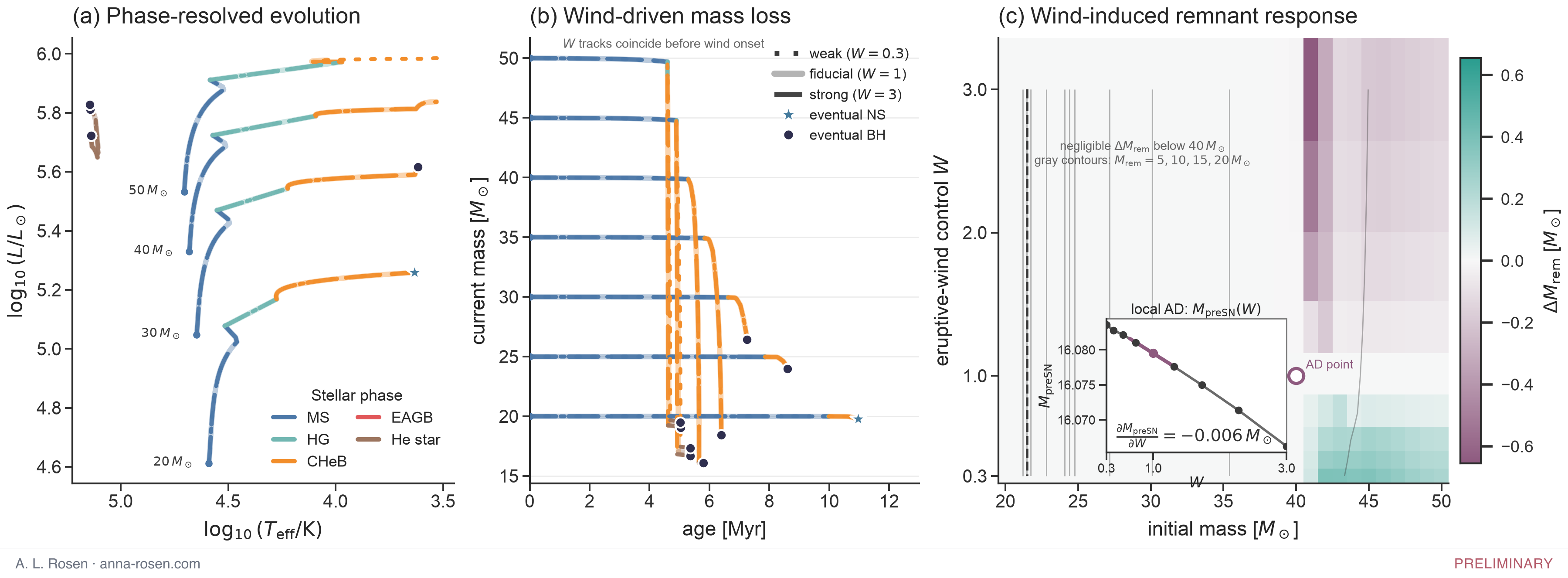
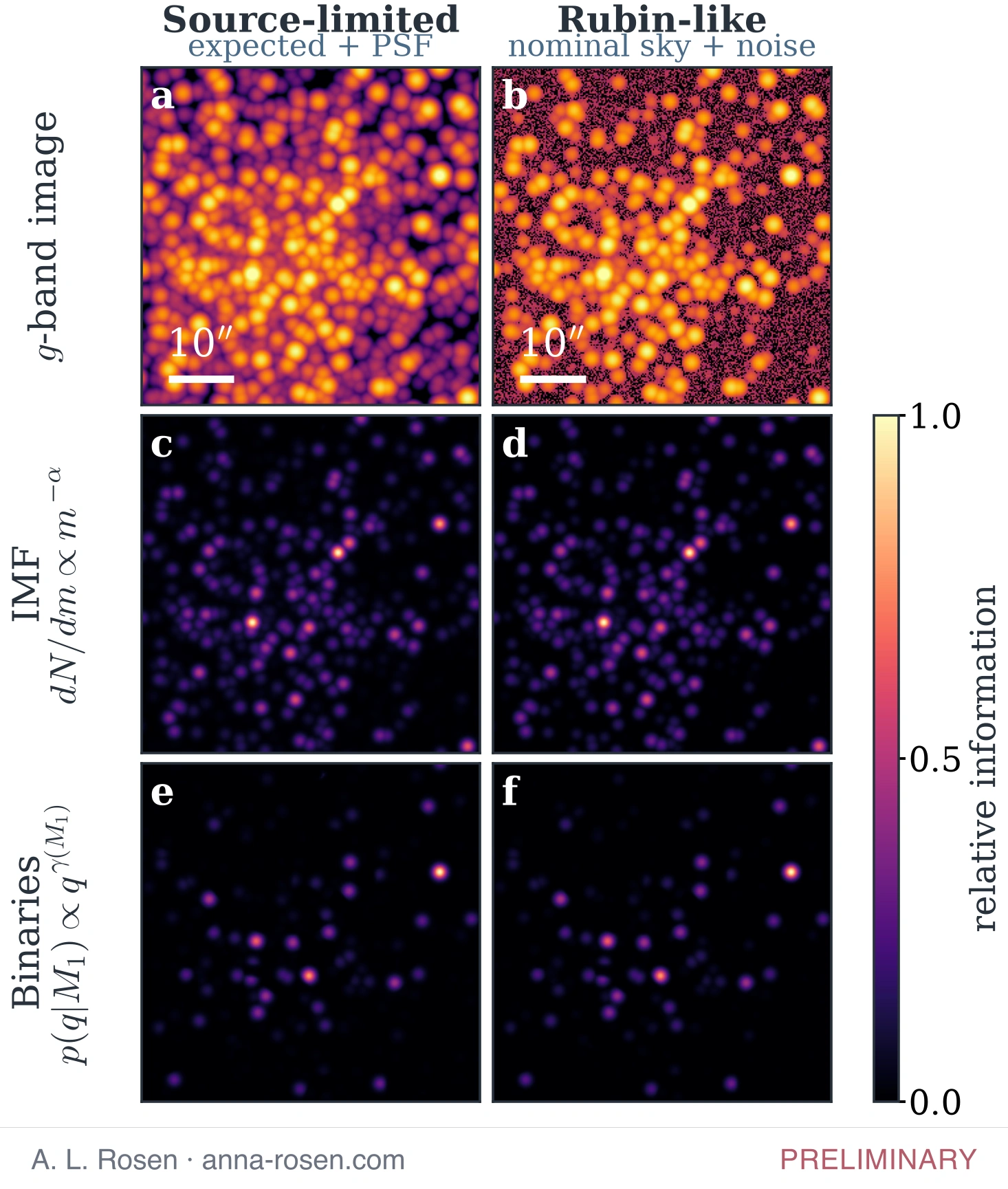
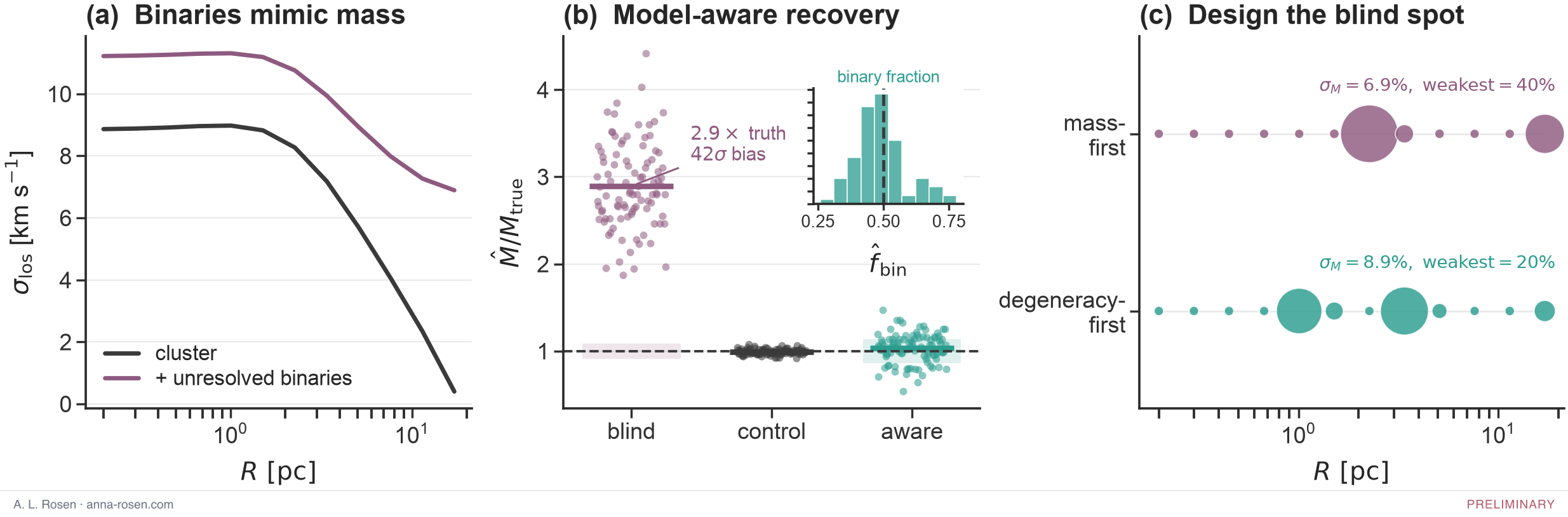
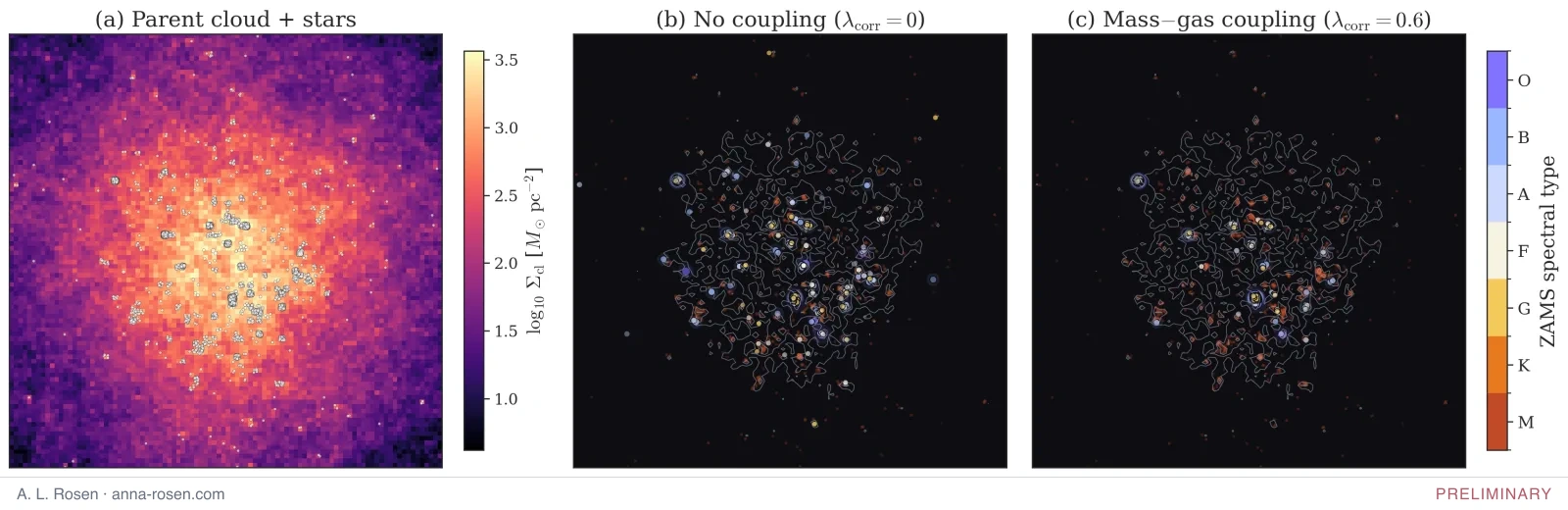
Jul 20What the Endpoint Remembers.A differentiable model has to earn the word. Here a 512-star cluster with a hard massive binary is evolved for three crossing times — the binary hardens, the cluster expands — and the endpoint's sensitivity to every birth parameter is obtained by differentiating straight through the adaptive timestep, agreeing with complete finite-difference reruns to three parts in a hundred thousand. The result is legible: cluster size remembers where the cluster started, the binary remembers its own orbit. That is what makes the model invertible against data rather than merely runnable.gravax →Jul 20Differentiable massive-star evolution connects uncertain winds to remnant outcomes.(a) Phase-colored H–R tracks and (b) mass-loss histories for 20–50M⊙ stars under weak, fiducial, and strong wind controls (dotted, solid, and dashed). The tracks coincide before wind activation and diverge as mass loss reshapes their evolution; symbols indicate eventual neutron-star or black-hole formation. (c) Wind-induced changes in remnant mass across the (MZAMS,W) response surface. The inset demonstrates an exact local adjoint sensitivity of pre-supernova mass—enabling gradient-based inference through stellar evolution rather than repeated parameter sweeps.startrax →Jul 19Which Pixels Know the Answer.This is what differentiable codes buy you. The same truth-known cluster is rendered as an idealised scene and as a nominal 30-second Rubin-like exposure with PSF, sky, Poisson and read noise (top). Differentiating that render with respect to the population parameters gives the Fisher information carried by every individual pixel — for the IMF slope (middle) and for the binary mass-ratio slope (bottom). Note that the two are not the same pixels: different physics is constrained by different parts of the image. You cannot make this map by running a simulation forward; it exists only because the whole pipeline carries gradients. Population-to-pixel differentiation is implemented; validated detector and survey transformations, and global recovery, are proposed work.fluxax →Jul 19The Telescope Adds Ten Pounds.Unresolved binaries inflate the observed velocity dispersion, and a binary-blind fit turns that orbital motion into 2.9 times the true cluster mass — while forecasting 4.5% precision. That is a bias 42 times its own error bar. Modelling the binaries recovers both the mass and the binary fraction, and the same machinery then says where to point the telescope next.informax →Jul 18Born Where the Gas Is.A truth-known synthetic cluster: natal gas surface density with an IMF-sampled population (left), then the same stars placed without (centre) and with (right) mass–gas coupling. With coupling on, massive O and B stars preferentially sit in dense gas — primordial mass segregation as a knob you can turn, which is what makes it testable.progenax →
On my desk
I'm writing the progenax methods paper, and I expect it out later this summer.
Confidently Wrong: Why Ignoring Binaries Biases IMF Inference at Large Sample Sizes is under review at The Astrophysical Journal — the referee report was positive. Read it on arXiv.
Nearly out the door
One masters student is finishing in August 2026.
Aisling AcunaBridging STARFORGE and SKIRT: A Synthetic Observation Pipeline for High-Fidelity Star Cluster Formation Simulations
Just finished
Surinder Singh ChhabraM.S. Computational Science — Data Science, SDSU · completed Summer 2026AstroRAG: Evidence-Aware Scientific Literature Retrieval — a multi-stage retrieval and evidence-summarisation framework for astrophysics literature discovery
Where the interesting problems are
gravax and startrax are taking most of the development effort.
gravaxDifferentiable collisional dynamics.In development
startraxFrom birth mass to stellar state and remnants.In development
Simmering
fluxaxPhysical states → survey observables.Far along
informaxWhat the data can actually recover.Far along
Teaching
It's summer — no classes, and the research runs at full tilt.