Research
What do star clusters remember, forget, and reveal?
Every question below is a facet of that one. I organize the work around questions, not topics — each spanning simulations, observations, and the software built to connect them.
How do massive stars assemble against their own feedback?
Massive stars shape galaxies even as they form — launching radiation, winds, and collimated outflows that push back on the gas feeding them. I build radiation-magnetohydrodynamic models to ask how a star keeps gaining mass despite forces strong enough to reverse its own accretion.
- Radiation pressure
- Protostellar outflows
- Magnetic fields
- Accretion
How does stellar feedback sculpt clusters and the interstellar medium?
The winds, radiation, and supernovae of young massive clusters carve bubbles, stir turbulence, and regulate further star formation. I connect simulations to multi-wavelength observations — from X-rays to the far-infrared — to trace where that feedback energy actually goes.
- Stellar winds
- H II regions & superbubbles
- Turbulence
- 30 Doradus & the LMC
What can observations genuinely tell us about stellar populations?
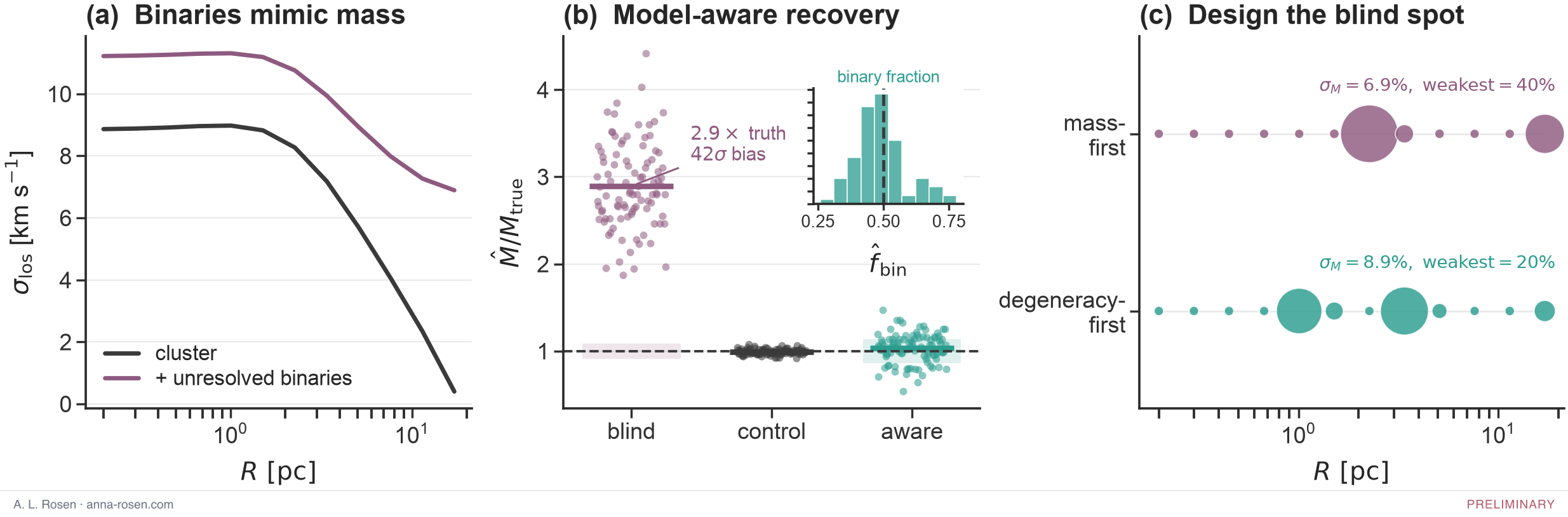
The initial mass function, binarity, and cluster structure are all inferred from incomplete data. I've shown that ignoring unresolved binaries can make high-mass IMF conclusions confidently wrong as samples grow. I want to know what surveys like Rubin and Gaia can — and cannot — actually recover.
- The initial mass function
- Unresolved binaries
- Identifiability
- Rubin/LSST & Gaia
 Preliminary · in prep
Unresolved binaries inflate the observed velocity dispersion, and a binary-blind fit turns that orbital motion into 2.9 times the true cluster mass — while forecasting 4.5% precision. That is a bias 42 times its own error bar. Modelling the binaries recovers both the mass and the binary fraction, and the same machinery then says where to point the telescope next.A. L. Rosen · Jaxstro (informax). Preliminary. How can differentiable models transform astrophysical inference?
If every step from a system's birth to its observed light is a differentiable function, we can compute exactly how each observable responds to the underlying physics — and design the observations most likely to break a degeneracy. This is the idea behind the Jaxstro ecosystem, and it reaches well beyond any one problem.
- Automatic differentiation
- Forward modeling
- Optimal experimental design
- Scientific software
 Preliminary · in prep
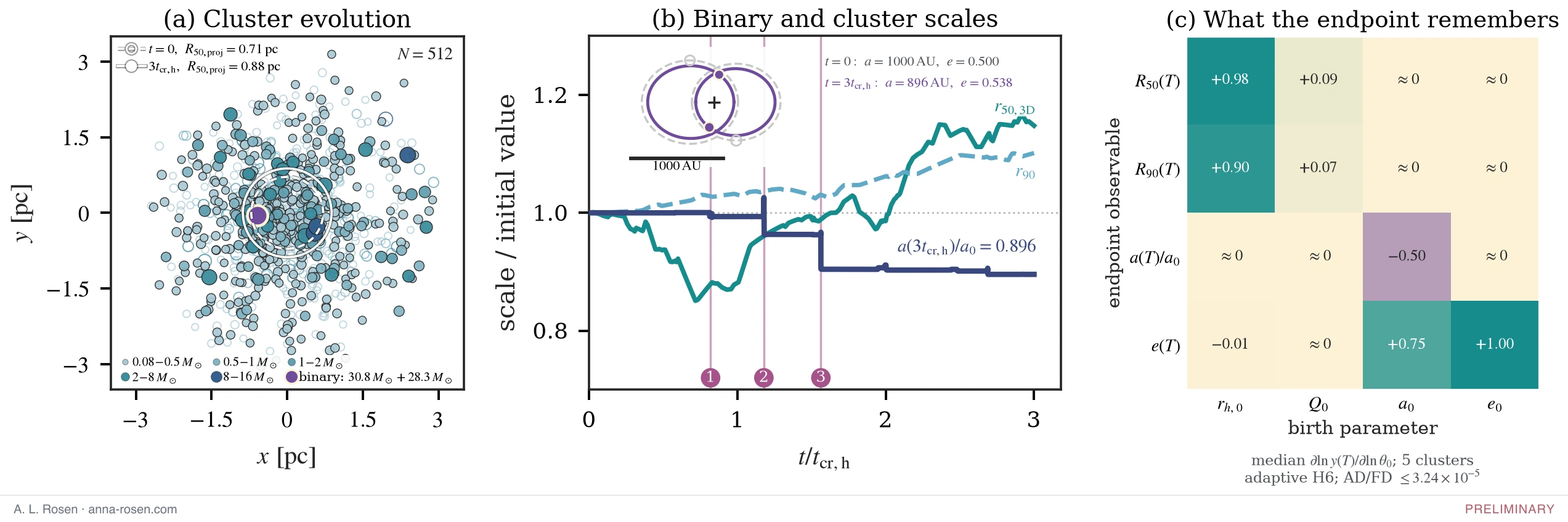
A differentiable model has to earn the word. Here a 512-star cluster with a hard massive binary is evolved for three crossing times — the binary hardens, the cluster expands — and the endpoint's sensitivity to every birth parameter is obtained by differentiating straight through the adaptive timestep, agreeing with complete finite-difference reruns to three parts in a hundred thousand. The result is legible: cluster size remembers where the cluster started, the binary remembers its own orbit. That is what makes the model invertible against data rather than merely runnable.A. L. Rosen · Jaxstro (gravax). Preliminary.