Exact Fisher-information geometry and local optimal experimental design, with simulation-based calibration, coverage and TARP gates — and refusal contracts that make a result decline itself when the data cannot support it.
Readiness
Far alongFar along · validated on truth-known problems
Publications
Methods paperplanned
Any inference method will return an answer. The harder question is whether the
data ever constrained it, and the usual failure is a confident posterior for
something the observation could not have measured.
informax works out what an observation can recover before it is taken, and
attaches a machine-checked verdict to every result, so an analysis can abstain
rather than report false precision. In its own head-to-head test of two design
strategies the gates abstained on both rather than declaring a winner, which is
the behaviour they exist for.
So far that is demonstrated on problems with known truth rather than on real
catalogues.
What's working
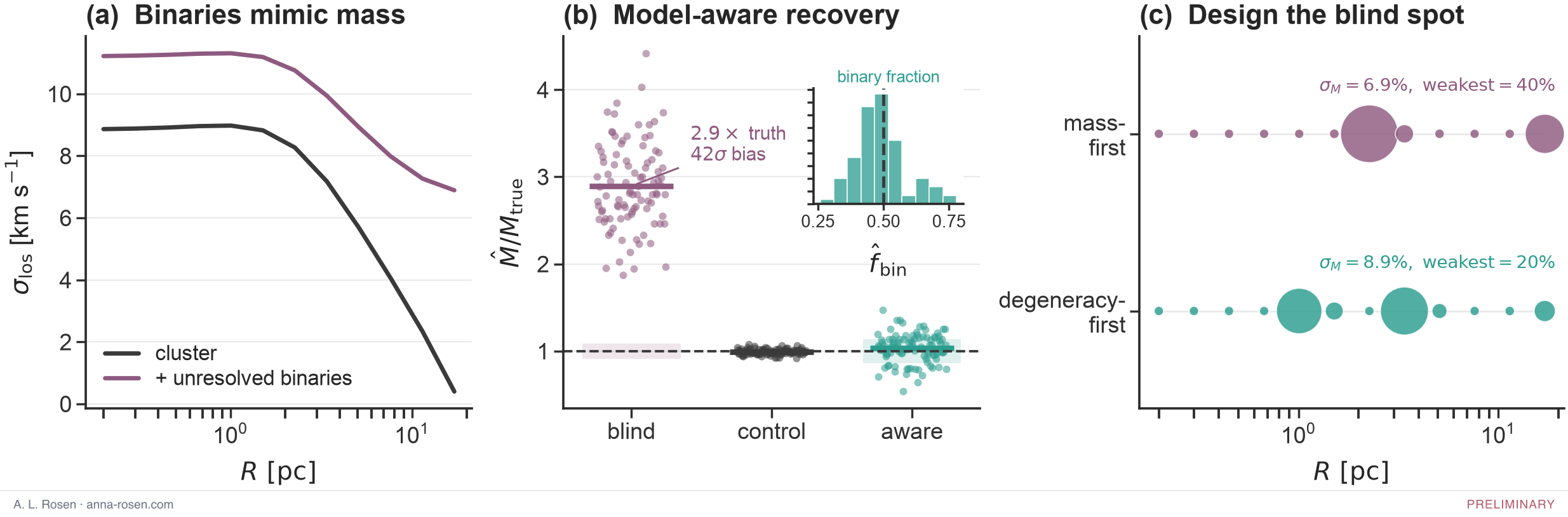
PreliminaryThe Telescope Adds Ten Pounds.Unresolved binaries inflate the observed velocity dispersion (a). A binary-blind fit turns that orbital motion into 2.9 times the true cluster mass — while forecasting 4.5% precision, a bias 42 times its own error bar. The control isolates the cause; binary-aware inference recovers both mass and binary fraction (b). Then the design question: a mass-first allocation buys 6.9% mass precision but leaves a 40% blind spot, while a degeneracy-first design halves that blind spot for two points of mass precision (c). Truth-known experiment, 96 mocks.
What's coming
Methods paper planned. It will establish the identifiability workflow: detect false confidence, repair the model, and redesign the observation.