A JAX-native, hierarchical collisional N-body engine: high-order exact direct gravity with explicit ownership of binaries and compact subsystems, and gradients that survive the adaptive timestep — so a cluster model can be fitted to data, not only run forward.
Readiness
In developmentIn active development
Publications
Methods paperplanned
Close encounters are where a cluster’s history is decided, so gravax resolves
them exactly rather than softening them away, and gives binaries and compact
subsystems an owner of their own instead of letting them dissolve into the
average. What sets it apart from the mature collisional codes is not speed: it
is that the trajectory stays differentiable throughout, so I can ask how a
cluster’s present-day state depends on the conditions it was born with and
answer with a derivative rather than a parameter sweep. The integrators are
checked against analytic solutions and independent reference methods rather
than against sky data.
Exact direct summation is what makes that trustworthy, and it is also what sets
the ceiling on (N). A differentiable treatment of the far field is in
development to lift it. The goal is cluster models at the million-star scale
that stay differentiable end to end, and followed far enough to cover a
cluster’s whole life rather than its first few crossing times — from birth
structure, through the epochs that rework it, to the point where it has been
erased. That work is not validated yet, and nothing above depends on it.
What's working
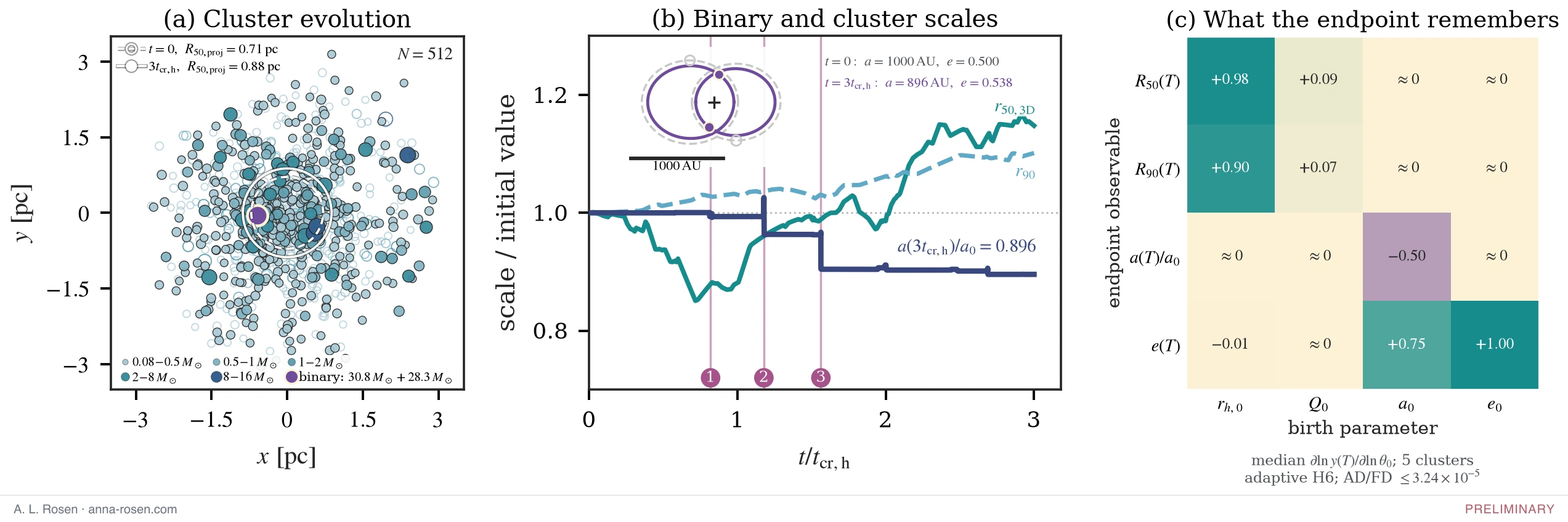
PreliminaryWhat the Endpoint Remembers.Birth conditions leave a readable fingerprint. A 512-star EFF cluster carrying a primordial 30.8+28.3M⊙ binary, evolved to 3tcr,h=2.447Myr under exact, unsoftened Newtonian forces. (a) Open symbols are the initial distribution and filled symbols the endpoint; the projected half-mass radius grows from 0.71 to 0.88 pc. (b) Three binary-single encounters harden the binary by 10.4%, from a0=1000 to 896AU, while the cluster expands and the binary ends at e=0.538. (c) The point: each cell is the median logarithmic response ∂lny(T)/∂lnθ0 of an endpoint observable to a birth parameter, across five clusters. The structure is physically legible — cluster size remembers rh,0, while binary hardening and eccentricity remember a0 and e0. Derivatives taken straight through the reversible adaptive timestep agree with complete finite-difference reruns to 3.24×10⁻⁵, so the differentiability claim is measured rather than asserted.
What's coming
In active development. Near-term work turns the validated adaptive high-order scheme into the standard cluster entry point and extends it to realistic mass spectra and primordial binaries. The methods paper will cover where exact resolution is required rather than merely faster.