A differentiable map from initial mass, age and metallicity to full single-star state — winds, mass loss, lifetimes, remnants — with gradients that survive the phase transitions, where differentiating naively does not.
Readiness
In developmentIn active development
Publications
Methods paperplanned
Stellar evolution is full of discontinuous moments: a star leaves the main
sequence, exhausts its envelope, becomes a remnant. Those transitions are
exactly where a naive derivative quietly stops being correct, so startrax
treats them explicitly — and the gradient converges where the obvious approach
does not.
The forward model is checked against the published formulae it implements
rather than against sky data, and the gradients are demonstrated at selected
masses and metallicities rather than across the whole domain. Extending them is
the current work.
What's working
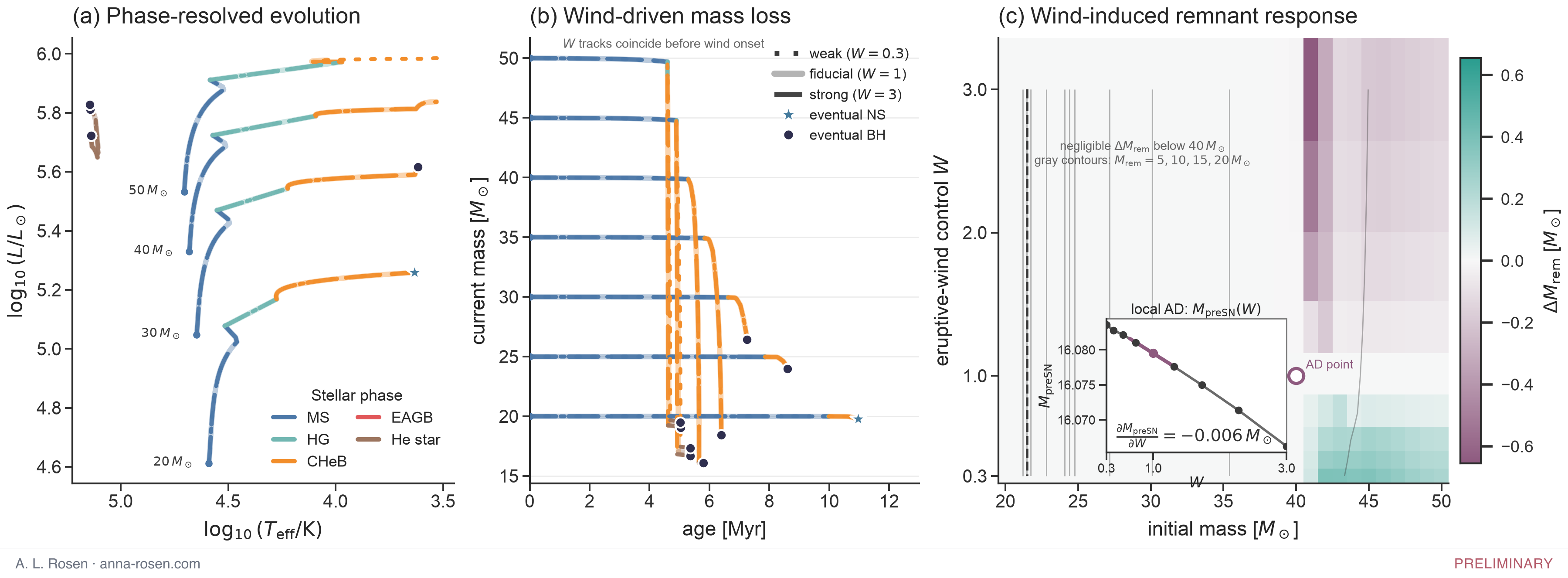
PreliminaryDifferentiable massive-star evolution connects uncertain winds to remnant outcomes.(a) Phase-colored H–R tracks and (b) mass-loss histories for 20–50M⊙ stars under weak, fiducial, and strong wind controls (dotted, solid, and dashed). The tracks coincide before wind activation and diverge as mass loss reshapes their evolution; symbols indicate eventual neutron-star or black-hole formation. (c) Wind-induced changes in remnant mass across the (MZAMS,W) response surface. The inset demonstrates an exact local adjoint sensitivity of pre-supernova mass—enabling gradient-based inference through stellar evolution rather than repeated parameter sweeps.
What's coming
In active development. Current work extends the demonstrated gradients from selected points across the full mass–metallicity domain.