A three-tier MSM ⊕ Hermite ⊕ SDAR engine that resolves close encounters exactly while accelerating cluster-wide gravity — mapping how dynamics preserves, transforms, or erases birth structure.
Readiness
In developmentIn active development
What's working
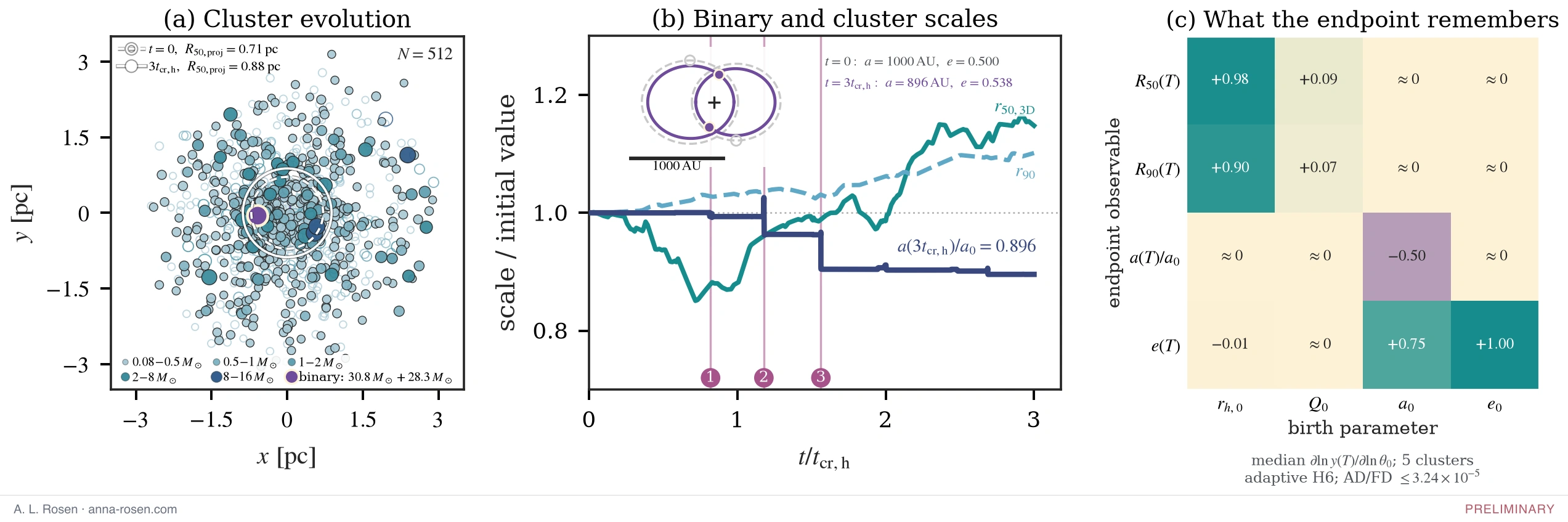
PreliminaryWhat the Endpoint Remembers.Birth conditions leave a readable fingerprint. A 512-star EFF cluster carrying a primordial 30.8+28.3M⊙ binary, evolved to 3tcr,h=2.447Myr under exact, unsoftened Newtonian forces. (a) Open symbols are the initial distribution and filled symbols the endpoint; the projected half-mass radius grows from 0.71 to 0.88 pc. (b) Three binary-single encounters harden the binary by 10.4%, from a0=1000 to 896AU, while the cluster expands and the binary ends at e=0.538. (c) The point: each cell is the median logarithmic response ∂lny(T)/∂lnθ0 of an endpoint observable to a birth parameter, across five clusters. The structure is physically legible — cluster size remembers rh,0, while binary hardening and eccentricity remember a0 and e0. Derivatives taken straight through the reversible adaptive timestep agree with complete finite-difference reruns to 3.24×10⁻⁵, so the differentiability claim is measured rather than asserted.
What's coming
In active development. The methods paper will cover the three-tier scheme and show where each tier is required rather than merely faster.