Differentiable Gaia and Rubin/LSST photometry, astrometry, and images, propagated through selection, crowding, PSFs, backgrounds, and noise.
Readiness
Far along
What's working
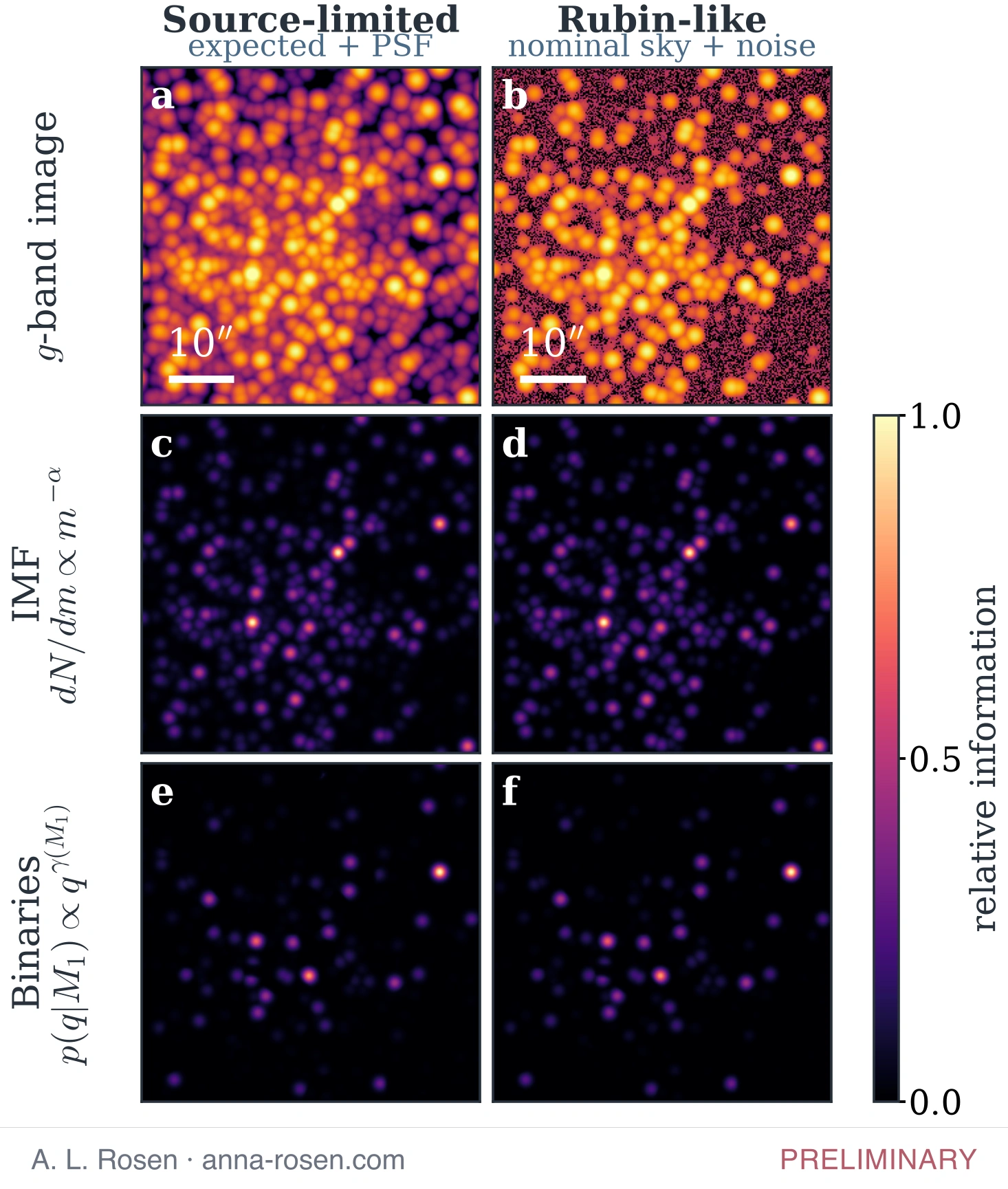
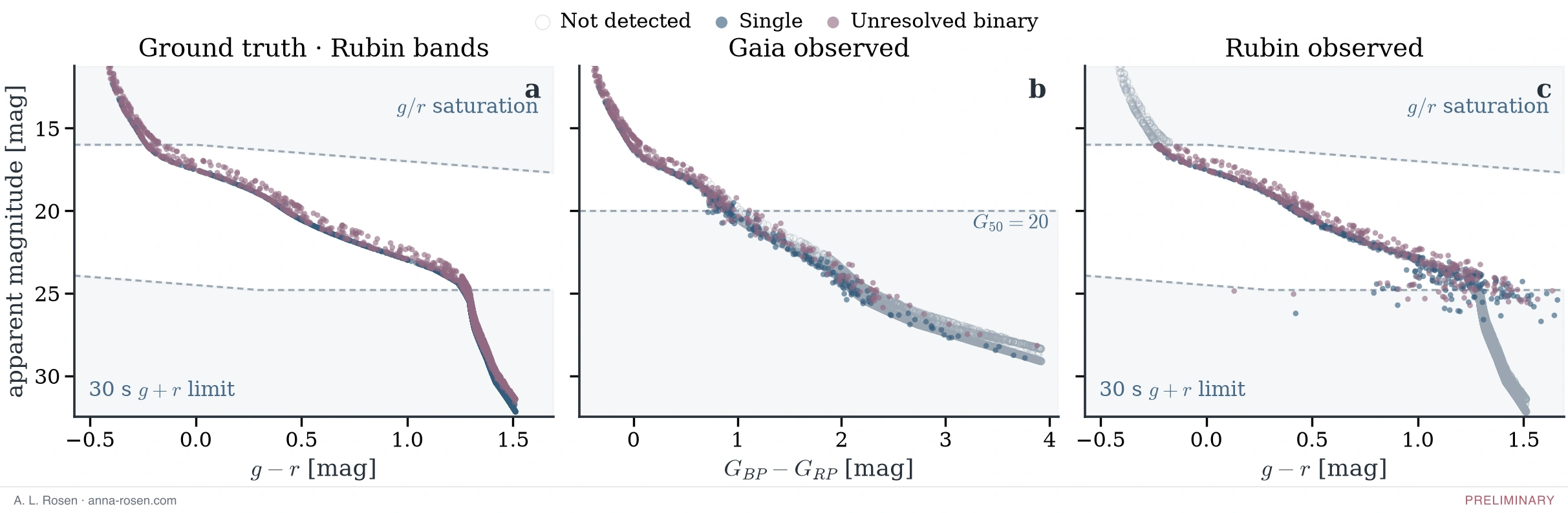
PreliminaryWhich Pixels Know the Answer.This is what differentiable codes buy you. The same truth-known cluster is rendered as an idealised scene and as a nominal 30-second Rubin-like exposure with PSF, sky, Poisson and read noise (top). Differentiating that render with respect to the population parameters gives the Fisher information carried by every individual pixel — for the IMF slope (middle) and for the binary mass-ratio slope (bottom). Note that the two are not the same pixels: different physics is constrained by different parts of the image. You cannot make this map by running a simulation forward; it exists only because the whole pipeline carries gradients. Population-to-pixel differentiation is implemented; validated detector and survey transformations, and global recovery, are proposed work.PreliminaryWhat Gaia and Rubin Actually See.One synthetic population, three views. Ground truth in Rubin bands (left); the same stars as Gaia would record them, with everything faint falling out below the detection limit (centre); and as Rubin would record them, reaching far deeper but saturating at the bright end (right). Unresolved binaries sit systematically above the single-star sequence in every panel. Selection, saturation and blending are part of the forward model, not corrections applied afterwards.
What's coming
Methods paper planned. It will cover the differentiable path from physical state to Gaia and Rubin observables, including selection, crowding and noise.